
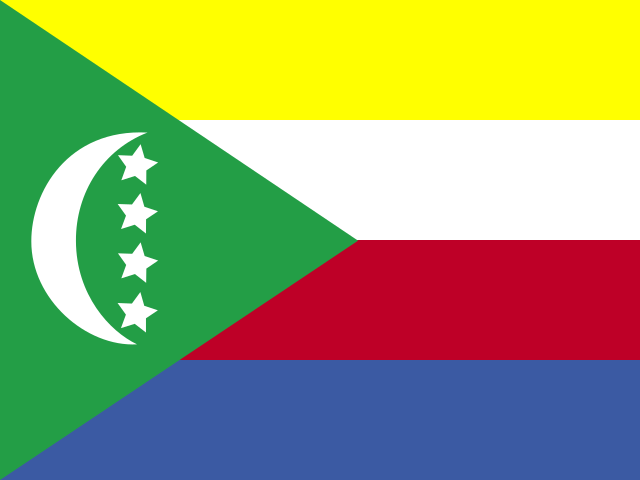
Comoros Country Summary
Medium Risk
View full Ratings TableSanctions
Lower Concern
FATF AML Deficient List
Lower Concern
Terrorism
Medium Concern
Corruption
Higher Concern
US State ML Assessment
Medium Concern
Criminal Markets (GI Index)
Medium Concern
EU Tax Blacklist
Lower Concern
Offshore Finance Center
Lower Concern
Please note that although the below Summary will give a general outline of the AML risks associated with the jurisdiction, if you are a Regulated entity then you may need to demonstrate that your Jurisdictional AML risk assessment has included a full assessment of the risk elements that have been identified as underpinning overall Country AML risk. To satisfy these requirements, we would recommend that you use our Subscription area.
If you would like a demo of our Subscription area, please reserve a day/time that suits you best using this link, or you may Contact Us for further information.
Anti Money Laundering
FATF Status
The Comoros is not on the FATF List of Countries that have been identified as having strategic AML deficiencies
Compliance with FATF Recommendations
The last Mutual Evaluation relating to the implementation of anti-money laundering and counter-terrorist financing standards in the Comoros was undertaken in 2024. According to that Evaluation, the Comoros was deemed Compliant for 11 and Largely Compliant for 12 of the FATF 40 Recommendations. It was deemed Highly Effective for 0 and Substantially Effective for 0 of the Effectiveness & Technical Compliance ratings.
Sanctions
The provided report content does not specify any international sanctions enforced against Comoros by other nations. Instead, it focuses on Comoros' involvement in sanctions evasion related to its economic citizenship program and the implications of such actions.
Criminality
Rating |
0 (bad) - 100 (good) |
|---|---|
| Transparency International Corruption Index | 21 |
| World Bank: Control of Corruption Percentile Rank | 19 |
Comoros faces significant challenges related to crime and corruption, characterized by widespread human trafficking, drug trafficking, and financial crimes, which are exacerbated by government corruption and political instability. Despite recent efforts to implement anti-corruption measures and enhance transparency, the resilience of the country against organized crime remains weak due to overburdened judicial systems, limited law enforcement capacity, and a largely informal economy that undermines regulatory frameworks.
Economy
The economy of Comoros is predominantly small and trade-based, with a significant reliance on agriculture, particularly the export of spices like vanilla and cloves, which contribute approximately 40% to the GDP. Despite its agricultural potential, the country grapples with high poverty rates, unemployment, and a lack of economic diversification, compounded by political instability and vulnerability to natural disasters. The investment climate remains challenging, necessitating structural reforms and infrastructure improvements to attract foreign direct investment, while ongoing efforts to privatize state-owned enterprises and enhance workforce training are hindered by a persistent dependency on foreign aid.
Subscribe to
Professional Plus

- Unlimited Access to full Risk Reports
- Full Dataset Download
- API Access
- Virtual Asset Risk Assessments
