
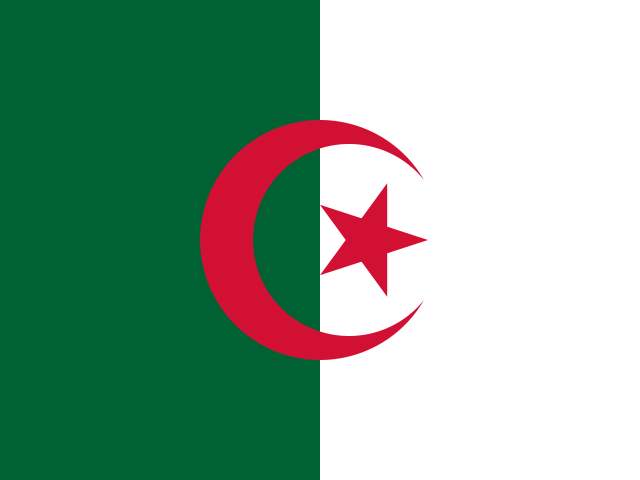
Algeria Country Summary
Higher Risk
View full Ratings TableSanctions
Lower Concern
FATF AML Deficient List
Higher Concern
Terrorism
Medium Concern
Corruption
Higher Concern
US State ML Assessment
Higher Concern
Criminal Markets (GI Index)
Medium Concern
EU Tax Blacklist
Lower Concern
Offshore Finance Center
Lower Concern
Please note that although the below Summary will give a general outline of the AML risks associated with the jurisdiction, if you are a Regulated entity then you may need to demonstrate that your Jurisdictional AML risk assessment has included a full assessment of the risk elements that have been identified as underpinning overall Country AML risk. To satisfy these requirements, we would recommend that you use our Subscription area.
If you would like a demo of our Subscription area, please reserve a day/time that suits you best using this link, or you may Contact Us for further information.
Anti Money Laundering
FATF Status
Algeria is on the FATF List of Countries that have been identified as having strategic AML deficiencies
Compliance with FATF Recommendations
The last follow-up Mutual Evaluation Report relating to the implementation of anti-money laundering and counter-terrorist financing standards in Algeria was undertaken in 2025. According to that Evaluation, Algeria was deemed Compliant for 2 and Largely Compliant for 18 of the FATF 40 Recommendations. It remains Highly Effective for 0 and Substantially Effective 2 with regard to the 11 areas of Effectiveness of its AML/CFT Regime.
Sanctions
The provided report content does not specify any international sanctions that are currently enforced against Algeria by other nations. Instead, it focuses on Algeria's involvement in sanctions evasion activities and its implications in relation to other sanctioned countries.
Criminality
Rating |
0 (bad) - 100 (good) |
|---|---|
| Transparency International Corruption Index | 34 |
| World Bank: Control of Corruption Percentile Rank | 30 |
Algeria faces significant challenges related to crime and corruption, with a notable prevalence of human trafficking, arms trafficking, and a substantial counterfeit market. Despite the government's efforts to combat corruption through the establishment of various anti-corruption bodies and legislation, issues such as state-embedded corruption and a large informal economy continue to undermine these initiatives, leading to a lack of effective institutional reforms and transparency.
Economy
Algeria's economy, heavily reliant on state enterprises and hydrocarbon production, presents a mixed landscape for foreign investment, characterized by both opportunities and challenges. While the government actively encourages foreign direct investment (FDI) in sectors such as agriculture, renewable energy, and healthcare, the business environment is complicated by regulatory uncertainties, protectionist policies, and a preference for local over foreign firms. Despite the potential for growth, foreign investors face hurdles including bureaucratic inefficiencies, shifting regulations, and the 51/49 ownership requirement in strategic sectors, which can deter smaller enterprises and complicate market access.
Subscribe to
Professional Plus

- Unlimited Access to full Risk Reports
- Full Dataset Download
- API Access
- Virtual Asset Risk Assessments
